
Reference Article: The Hindu
UPSC CSE Relevance:
– GS Paper III: Indian Economy, Investment, Industrial Policy, Ease of Doing Business
Recent data on investment announcements in India present a mixed picture with significant policy implications. New private sector project announcements touched a near 15-month high of ₹9.9 lakh crore in the first half of FY26, driven overwhelmingly by domestic firms. Historically, Indian firms have been the backbone of private investments, but their dominance has now intensified — from 77% in 2018-19 to 94% this fiscal year. This reflects an optimistic outlook among domestic firms, in sharp contrast with the caution displayed by foreign investors.
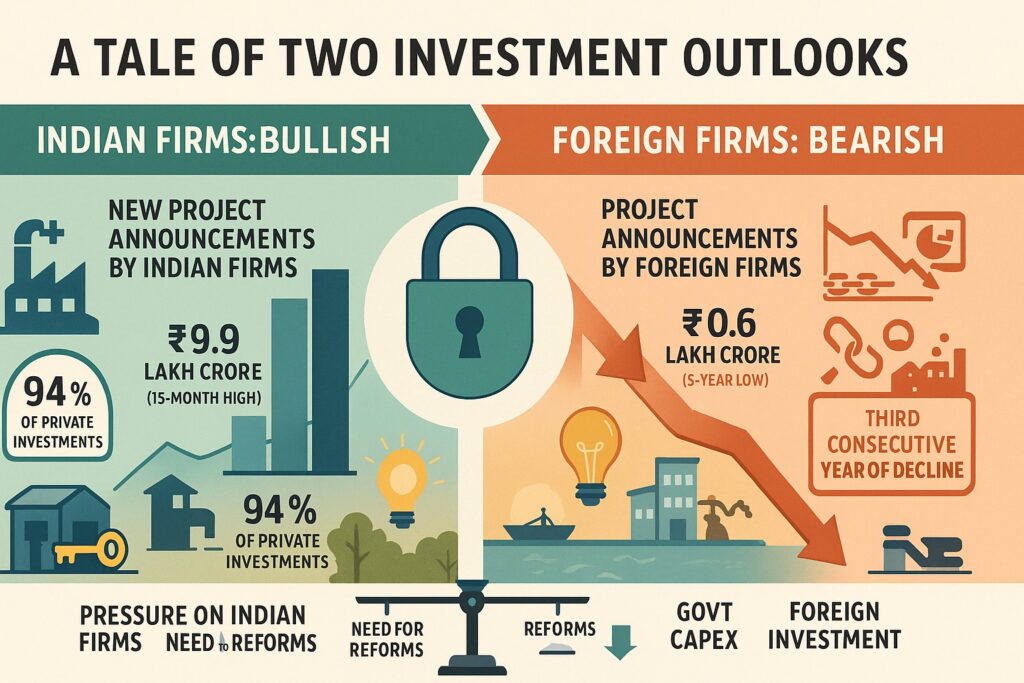
Encouragingly, not only announcements but even the value of projects completed by Indian firms has touched a 15-month high, validating actual progress. The manufacturing sector emerged as the primary focus for these investments, signifying structural strengthening beyond short-term policy incentives. Importantly, most investments were announced before the August GST rate cuts, reflecting confidence rooted in long-term fundamentals rather than temporary demand boosts. If these commitments materialize, they could give the government greater fiscal flexibility to focus on developmental and defence priorities.
Domestic vs. Foreign Investment Trends
- Domestic Firms: Optimistic, driving 94% of new projects, concentrated in manufacturing.
- Foreign Firms: Announcements fell to ₹0.6 lakh crore in H1 FY26, the lowest in five years, marking the third consecutive annual decline.
- Global Context: Despite India’s fall, global investment outflows grew by 11% in 2024 and 3% in 2023.
Causes of Divergence
- Tariff frictions with the U.S. denting foreign investor confidence.
- Pre-existing foreign disinterest even before trade tensions.
- Global pandemic aftershocks but India-specific issues of regulatory and policy uncertainty.
Government Investment
- New project announcements by government fell sharply to ₹1.5 lakh crore, down 71% from last year.
- Reflects Centre’s earlier warnings of slower capital expenditure growth.
- With both government and foreign firms pulling back, pressure mounts on Indian private players to sustain momentum.
Policy Lessons
- Urgent need to deepen ease of doing business reforms to sustain domestic confidence and attract foreign investment.
- Balancing fiscal prudence with continued infrastructure and industrial push.
- Building credibility as a stable, predictable investment destination to avoid over-reliance on domestic capital.
Conclusion
The current investment cycle reveals a paradox — Indian firms are bullish, while foreign firms remain cautious. While this provides some relief to the government’s growth strategy, sustaining momentum will require reforms, transparency, and consistent policy to attract global capital. Otherwise, overdependence on domestic players could expose vulnerabilities in India’s growth story.